
A Cowboy’s Prayer
Commonly attributed to Badger Clark
Our Heavenly Father, we pause at this time,
mindful of the many blessings you have bestowed upon us.
We ask, Lord, that you will be with us in the arena of life.
We as cowboys do not ask for special favors.
We don’t ask to draw around the chute fighting horse,
the steer that won’t lay, or to never break the barrier.
We don’t even ask for all daylight runs.
We do ask, Lord, that you will help us live our lives here on Earth as cowboys,
in such a manner that when we make that last inevitable ride
to the country up there—where the grass grows lush, green, and stirrup high,
and the water runs cool, clear, and deep—that you will take us by the hand and say:
“Welcome to Heaven, cowboy. Your entry fees are paid.”
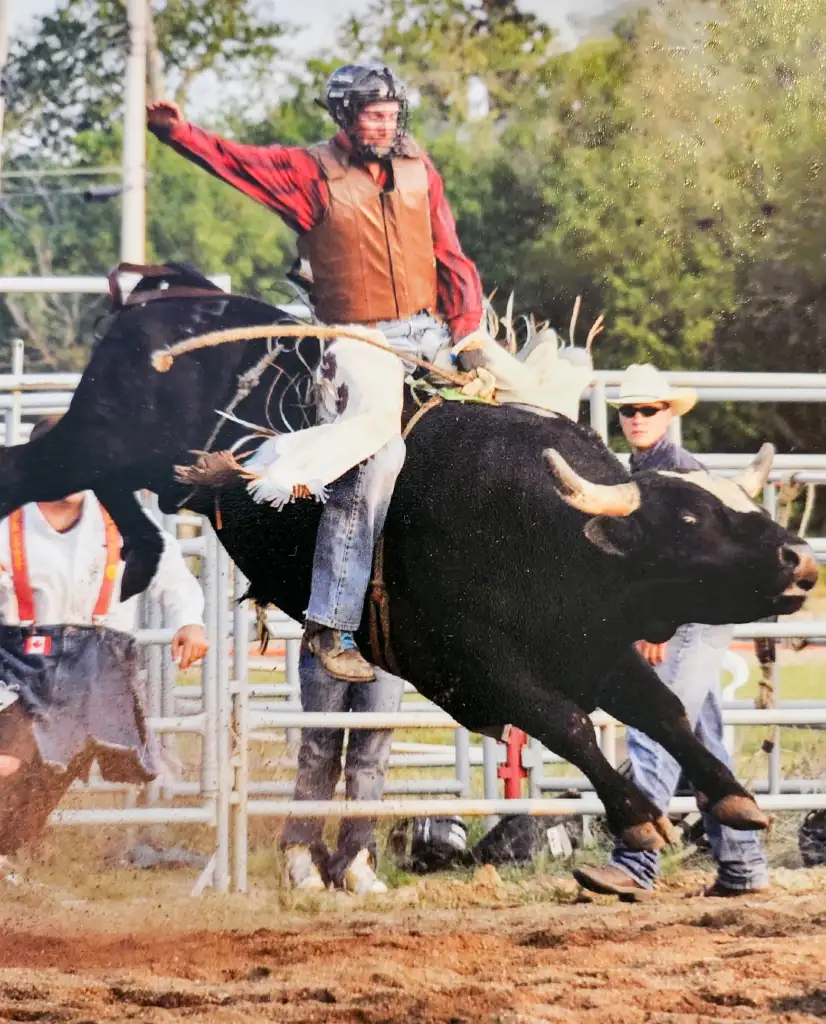
Jamie Vang – Bull Rider, Fireman, Husband, and Father, born on January 21, 1987, to Huey and Joanne Vang, in Black Diamond, AB.
“I don’t remember much about that day… I remember I went into the finals. I probably shouldn’t have been competing, since I was already pretty beat up. But, with it being my rookie bull riding year, I just wanted to push through the pain. Now there’s a year of my life I don’t remember.” – Jamie Vang
According to Jamie Vang’s mom, Joanne, Jamie drew what’s known as a “headhunter.” A bull that is dangerously aggressive. A bull that actively attempts to gore a rider with its head or horns after the bull rider has fallen. These bulls tend to focus on the rider rather than just bucking.
That fateful day my son was pulled down by the bull’s horns. He was knocked unconscious and a skilled rodeo clown, Dennis Halstead saved my son’s life. Dennis got Jamie’s airway cleared so he could breathe, then gave the ambulance paramedics critical information on his status. Jamie was taken to a hospital in Lethbridge and from there was airlifted to Calgary, where he spent about 4 months in therapy recovering from his head injury. My thanks go out to Dennis and also the rodeo community for the amazing support following his injury.
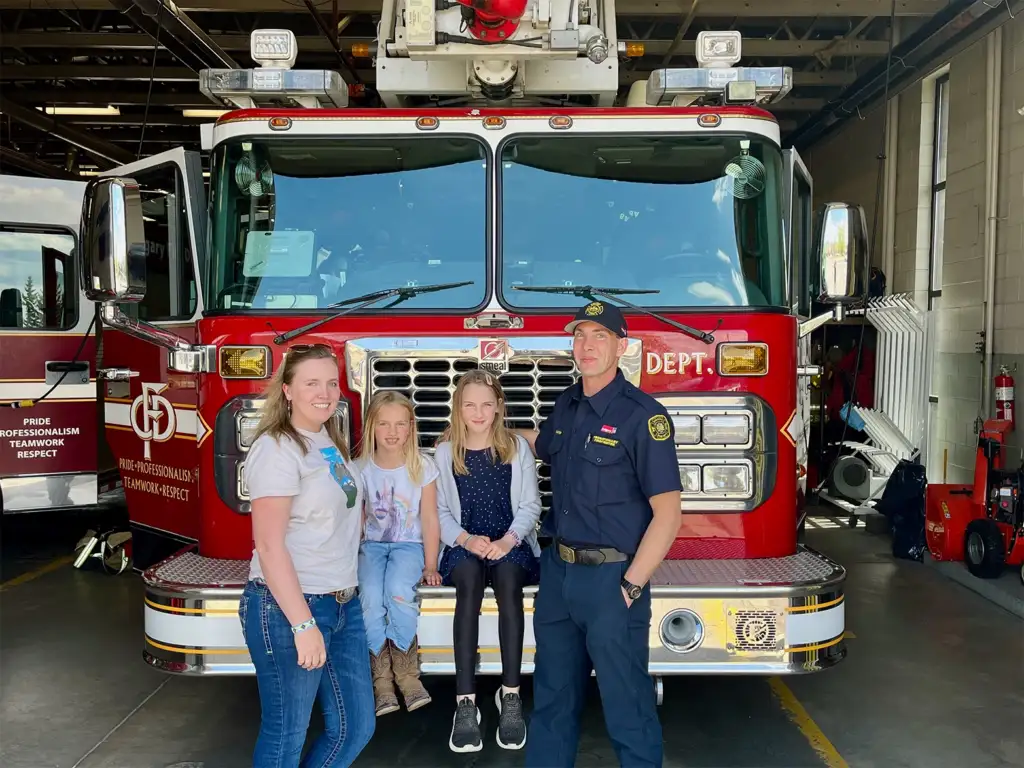
I followed in my father’s footsteps and started riding bulls at the Johansen bull riding school in Balzac, AB, in May of 2004. I was riding in the Chinook Rodeo Finals, where I sustained a serious head injury, where Dennis Halstead was clowning, thankfully! Dennis stepped in with his fire department medical training and was able to stabilize me on the arena floor. Further stabilization was done at the Lethbridge Hospital so I could be airlifted to the Foothills Hospital in Calgary.
It took six months to recover enough to return to bull riding. The doctors wanted me to take a year off, but I was eager to compete again. In 2006 I was awarded a rodeo/athletic scholarship to Frank Phillips College in Borger, Texas, where I competed as a bull rider until 2013, when my first daughter Brooke was born. I didn’t make any finals in 2013, so I hung up my rope and walked away from the rodeo scene, other than to help some friends. In 2016 I was blessed with another daughter, Adalyne. Once I quit rodeo, I worked construction and oil patch, living on my acreage with my wife Jill and my two daughters. In 2021 I hired on with the City of Calgary Fire Department, which was a long process. With the help of friends and family, I’m in my dream career.
My head injury has altered my life. I think I am very lucky; I know some guys have gone through similar events but have both motor and cognitive loss. I still, at times, especially when I’m tired, have difficulty finding a word or putting words together properly. When I was going through the application process to become a firefighter It took me a long time. Each step of the process had extra challenges due to my brain injury. When I was a rookie firefighter, one of my captains noticed the difficulties I was having remembering some things. He understood some of what I was going through because his own brother had suffered a brain injury.
Q. Did you ever go back to bull riding? In 2014 my cousin and I were invited back to the Cops Rodeo with the fire department. Dennis Halstead brought some firefighters out to learn how to ride bulls. I was talking to the firefighters, and that’s what got me interested in becoming a firefighter. At that point in my life, I had no plan for what I was going to do after my bull riding career. I thought I was just going to be doing steel-toed jobs my whole life. Dennis Halstead, who was a rodeo clown and Calgary firefighter, saved my life at the rodeo in Lethbridge, and he inspired, supported, and helped me in my quest to become a Calgary firefighter. I owe him so much, and I am glad we are great friends. In 2015 I did ride one more bull, where I won, at the Cops Rodeo.
Q. How do you feel about Dennis Halstead? I thank God for him—I wouldn’t be here, alive, today without him. He’s a truly genuine person with a great sense of humour. He is a retired firefighter who was really respected. As a rodeo clown, Dennis is the best. I knew him before I got hurt and even helped him with his clown act once
Q. Would you ever consider becoming a rodeo clown? No way! Dennis is really witty and quick mentally and physically. He keeps saying he’s going to slow down, but he loves what he does. He, at 65 years old, is still going strong, leaping in and out of barrels, keeping rodeo athletes safe while entertaining crowds.


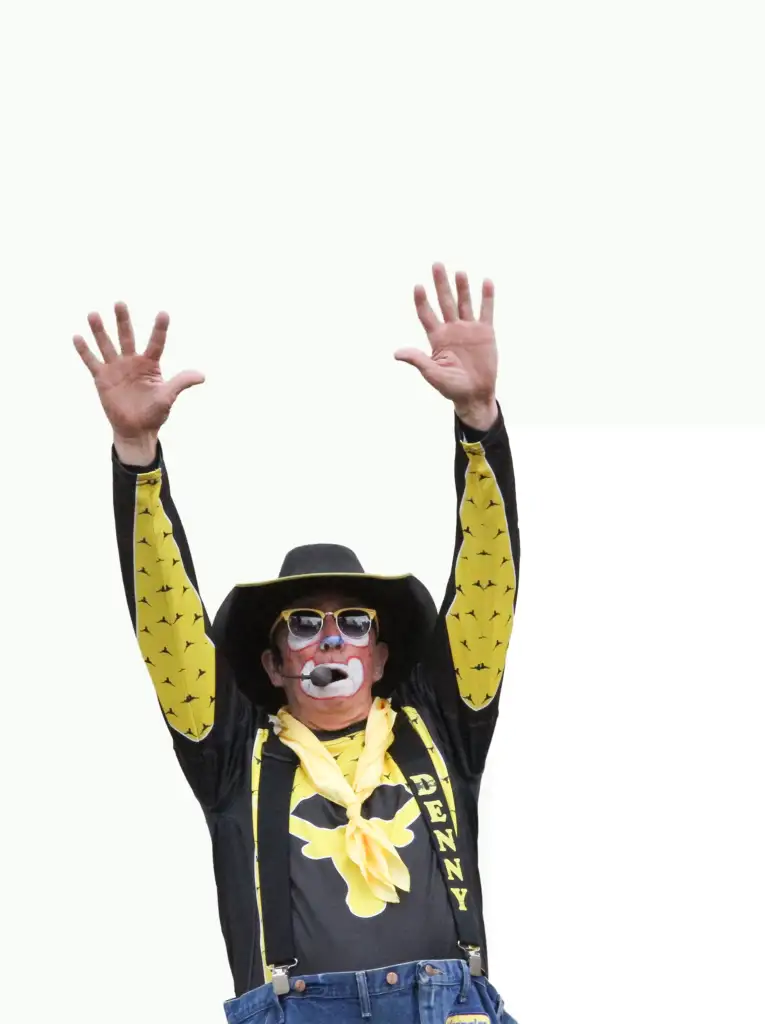
Dennis Halstead – Firefighter and World Renowned Rodeo Clown
Seven-time Canadian Pro Rodeo Entertainer of the Year, two-time Canadian Finals Rodeo Clown/Barrelman, and three-time Dodge Ram National Circuit Finals Rodeo Clown/Barrelman.“From fighting fires to staring down bulls, Dennis continues to put his life on the line in his second career as a rodeo clown and bullfighter.” By CTV News, July 8, 2015. In 2026 Dennis is still having a fulfilling and exciting career. He’s 65 years old and says he has broken every bone but continues to entertain crowds of rodeo fans and protect rodeo athletes with a grin and twinkle in his eye.
Q. Can you tell me about that fateful day Jamie Vang lay unconscious in the arena dirt after getting hit by a “headhunting” bull? Jamie was a young bull rider, kind of an up and comer. When he came out of the chute, the bull was really aggressive, and even though Jamie was an aggressive rider, he ended up getting thrown off like a lawn dart, thrown head first into the ground. I’ve been in the business for a long time, 31 years, and I’ve seen a lot of stuff. Once Jamie hit the ground, I knew he was hurt. When I got to him, he was having convulsions, and he was out cold. I thought he had broken his neck, for sure.
Back then they only had St. John’s Ambulance first aiders at the rodeo, and I’ll be honest with you, sweetheart—this guy didn’t have a clue what he was doing. The biggest thing with a brain injury is to get as much oxygen to the brain as possible. It’s one of the secrets to helping a person with a brain injury before they get to a hospital. I asked the first aider to turn on his oxygen bottle to 15 litres per minute. He said, “I don’t think mine goes that high.” So, I took what he had and started putting oxygen into Jamie. His tongue started swelling because he was going into convulsions. I grabbed what is called an OPA. (OPA, or Oropharyngeal Airway, is a curved, rigid plastic device used in emergency medicine to help keep the airway open in unconscious patients by preventing the tongue from blocking the throat.) Anyway, I grabbed one of those and got his tongue down and then monitored him closely until the ambulance got there to take Jamie to the hospital.
He was in the hospital for a long time. I received a call about 6 months later saying they were having a benefit for Jamie and asked if I’d be interested in coming. They presented me with an award. When I accepted the award, I told them that it was an honour, but I said, “To be honest, if you want to thank anybody, you should call the Calgary Fire Department because if it wasn’t with the training I received as a firefighter, I would have been standing beside Jamie, not knowing what to do.
Now to turn the story around, Jamie is a firefighter too now. Jamie called me when he was thinking about applying; I told him it’s the best job in the world—go for it! He works hard; as a firefighter, he has a wife and kids. I tell you, he could have quit so easily after his bull riding accident, but he didn’t!
Q. What you do at rodeos as a clown has so many sides to it—you’re an entertainer, but there’s a serious side that I don’t think spectators notice, the safety part of your career? I play the most dangerous sport in the world. It’s entertainment, but it’s dangerous! I’ve been in the arena when two guys have been killed. Both times it happened on a beautiful sunny Sunday afternoon. Both riders were crushed by bulls.
From a rodeo fan’s point of view, they go to the rodeo to see danger and mishap. It’s like going to a car race. There’s going to be a wreck, and people go to rodeos to see wrecks. That’s just human nature. I guarantee if there is a good wreck on Friday night, there will be two hundred more tickets sold for Saturday night. Being a rodeo clown is a tough career; you’re not going to do this job and not have aches and pains. It can become a problem in the long run.
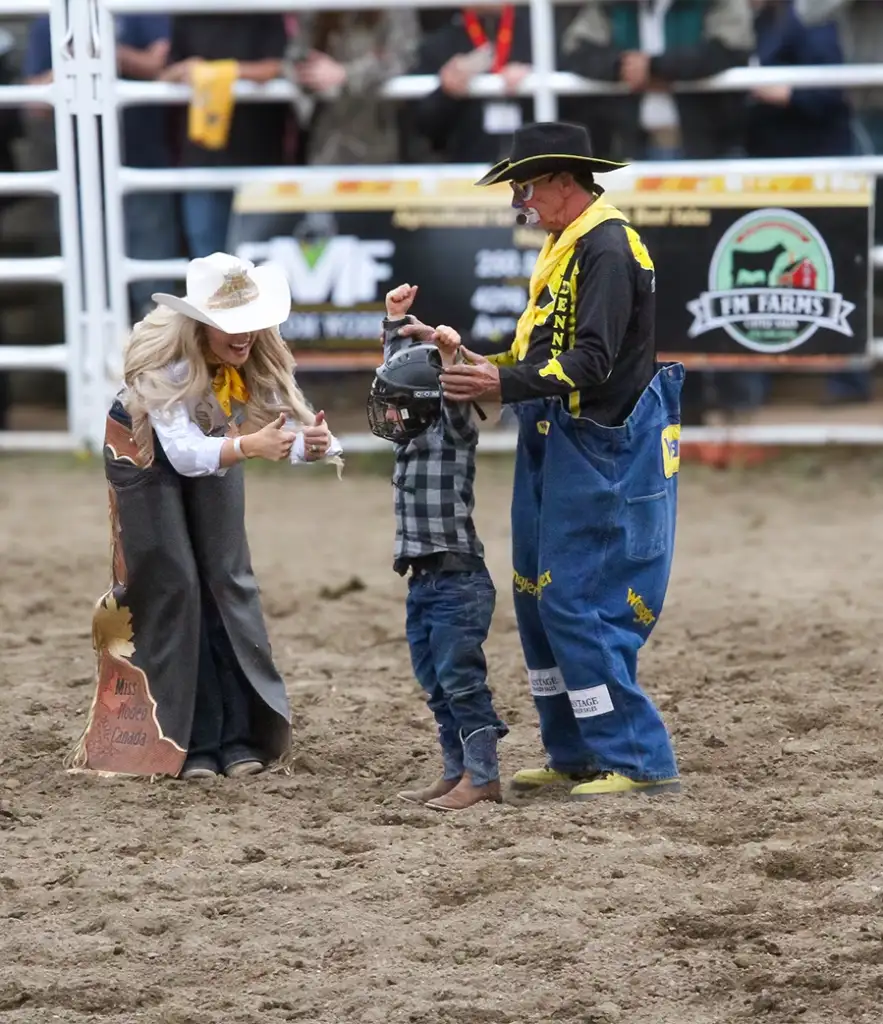
Q. You’ve been lucky to have a long career; on average, how long is a rodeo career? Very few guys have had the long career I have. The bronc and bull riders in general last about 5-6 years; very few guys last 10-12. Out of two hundred bronc riders in Canada, there may be 3-4 that get a 10-12 year career; the same goes for bull riders – the injuries just pile up. I’ve broken every bone in my body. Not sure what my body is made of, but at 65 I can still run and jump into my barrel. Being in a barrel with a bull smashing into it is like being in car accidents repeatedly.
Q. So Dennis, who are you clowning around with these days? My friend Brett Monea has been with me pretty much since he started as a young bullfighter. Our sport is family. Brett’s been a bullfighter for over twenty years. For twenty years we’ve travelled together. I’ve watched his kids grow up. It’s like going camping with your best friend every weekend. Our bond is so close! Right now, he is Canada’s top bullfighter.
Brett Monea – Professional Bullfighter and Entrepreneur
Co-founder of the Ultimate Bull Fighting Experience
Q. Are there differences between bullfighters and rodeo clowns?
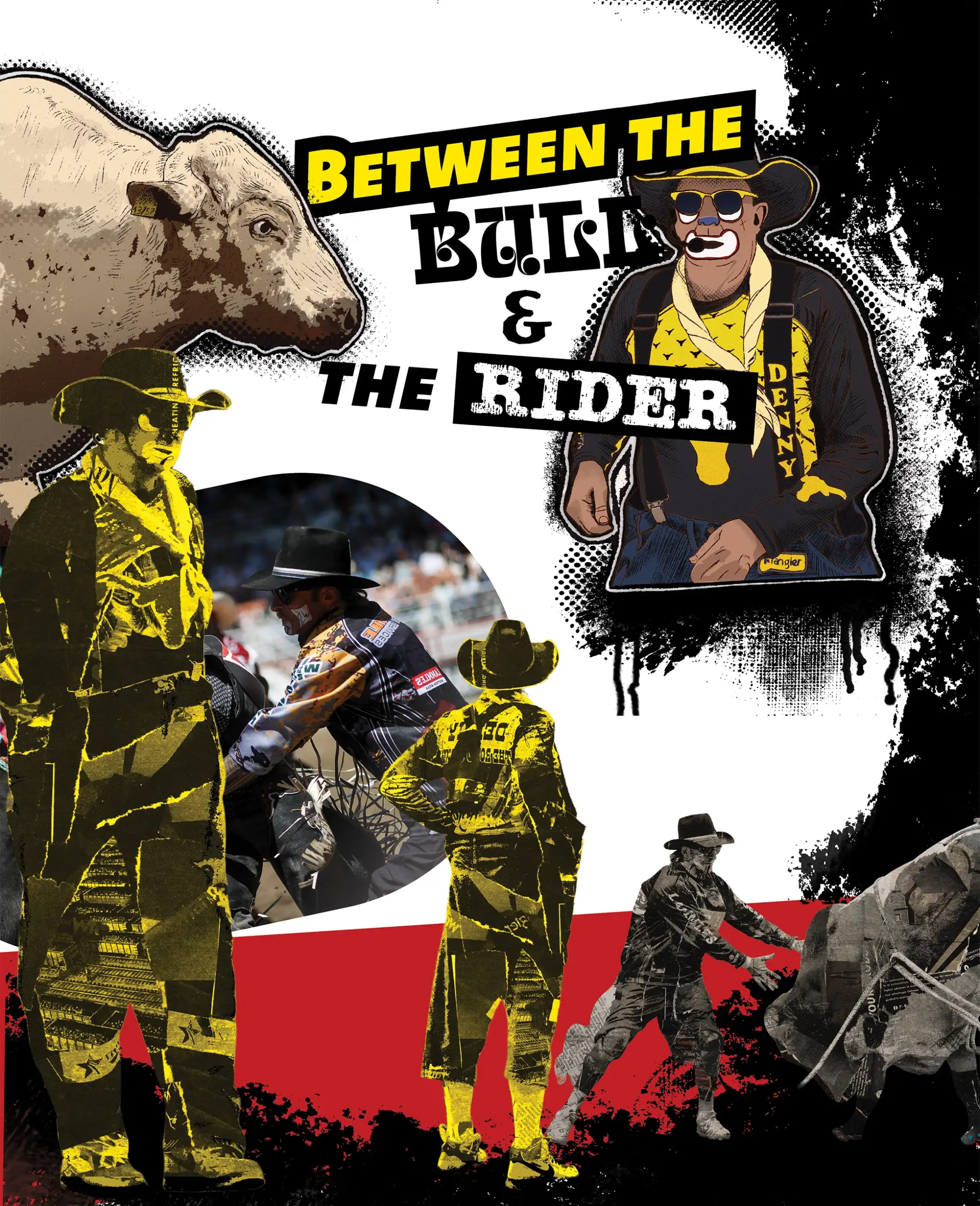
Yes, very distinct differences. Rodeo clowns are there strictly to entertain the crowd, fill the gaps when there’s a pause in the action, and get the crowd engaged and having a good time. They do so by telling jokes and having acts that they do throughout the rodeo performance. They usually have a barrel in the arena during the bull riding; it acts as an island of safety for bull riders and bullfighters if they are stuck in the middle of the rodeo arena with an aggressive bull. They usually wear face paint and have long baggy pants and a western shirt with their own distinct style. Bullfighters are there strictly to protect bull riders during the bull riding event. Their job is very serious and dangerous, and they do their best to do everything possible to make sure the bull riders get away safely.
Q. How do bullfighters do their job?
It’s the bull rider’s job to attempt to ride the bull for 8 seconds—50 points for the rider and 50 points for the bull. Those two are added together for a top score of 100 points. The highest score wins. So, if either the bull rider rides his bull for 8 seconds or gets bucked off early, it’s our job to distract the bull so the bull and rider can both get to safety. There are always two bullfighters and sometimes three (depending on the rodeo or bull ring), and we work together to distract the bull using our knowledge of cattle and our athletic ability. When everything goes smooth, you may not even notice the bullfighters, and when there’s a wreck, the good bullfighters are in the middle of it.
Some bullfighters wear large pants that are cut off (called baggies), and some still wear face paint. Others wear more of an athletic-style outfit with no face paint. The bullfighter can choose his own style to a certain extent. I like to wear face paint at rodeos and an athletic jersey and shorts with my personal sponsor on it. I wear a protective vest underneath the jersey, wear a good set of knee braces, and have a football-style cleat for traction in the arena.
In an article written in the Albertan by Simon Ducatel, October 18th, 2020, you mention a few interesting points about your Ultimate Bullfighting Experience (UBE). I have a few follow-up questions related to your quotes in that article. “We’ve had farm kids with similar stories to mine…”
Q. What is your story? What or who inspired you to begin your education, training, and eventual career as a professional bullfighter? I grew up on a seed-stock farm west of Wetaskiwin, actively involved in hockey, 4-H, and team roping in the practice pens. My dad enjoyed roping so much that he built an indoor arena with roping chutes in it. I had a couple of 4H friends that were a couple of years older than me that started bull riding, so what do 4H kids do? They build their own bucking chutes and put them in my dad’s arena. We would buck cows there weekly, having school friends come over to watch for entertainment. I would get on the odd cow, although I enjoyed trying to turn them back for my friends riding them or distracting the cow away from them if they got bucked off or lasted the 8 seconds to dismount. One day a bull rider’s mom asked me, “Why don’t you go to bullfighting school?” Honestly, I never thought about it until then. So, the next week I enrolled in the TJ Baird and Jason Davidson bullfighting school in Balzac, AB. It was a three-day school, which I survived, and that was in March of 2001. I’ve been doing it ever since.
Q. Have you started the rodeo school, the Brett Monea Bullfighting Academy? And how will the academy train future bullfighting athletes? I changed up the idea of the bullfighting academy. A good friend of mine, Kynan Vine, and I came up with the idea during Covid—offering a unique experience to people that don’t want to be bullfighters but do want the experience of what it involves. So, we came up with the Ultimate Bullfighting Experience (UBE), and I’ve been running it ever since. At these experiences we do not allow participants to fight live cattle. They can go to a traditional rodeo school for that, if they decide to pursue bullfighting further, although my great team of professionals and I might fight one at the end for a demonstration.
Q. You mentioned, during our phone conversation, that you offer participants of all ages and abilities an opportunity to engage in a unique bullfighting experience. Can you elaborate on the UBE experience? I live southwest of Carstairs on 150 acres and take care of about 120 beef cows with my beautiful wife Amy and our two children, Wesley and Kate. We named our ranch Rafter U Ranch and Wellness Centre. Amy is a clinical social worker. She offers many different modalities of therapy. One that I’ll talk about how she partners with a horse to offer therapy to people. Horses are amazing animals, and when partnered with a professional, like Amy, I feel that the therapy session is just that much more impactful. We can combine the “Equus Experience” and the Ultimate Bullfighting Experience as well as cattle handling to give people a chance to be close to the animals. We can also take these experiences on the road and offer them at different venues for different organizations. We offer programs to children and adults alike. The kids’ program is modified for safety. People get a first-hand experience that they wouldn’t usually be able to get.
Advice from Brett for youth who want to pursue a career as a rodeo bullfighter. Be a good person and be patient. The only way to learn how to drive a car is by driving a car; the same is true for bullfighting. You need to go to the practice pen after practice pen to work on the craft. The sport demands a strong work ethic, or you’re not going to last. You need to be able to get the fundamentals down on how to protect yourself in the arena against a 1,700 lb bull. If you can’t protect yourself, how can you expect to protect bull riders? You’re going to make mistakes (that’s how you learn anything in life), although in this sport, when you make them, it will seriously injure you. So, you will realize very fast how bad you want this.
Advice from Dennis for youth who want to become rodeo clowns. You need to be very athletic and brave. At 65, I still am able to jump in and out of a barrel. You need to be funny and will perform in front of hundreds to thousands of people. Although the job entails being an entertainer, I still have a responsibility to protect bull riders while I engage the audience.
Article by Laureen James, photos of Jamie Vang were submitted by Jamie Vang with permission, photos of Dennis Halstead were taken by Saddle Up Magazine, graphics were done by Saddle Up Magazine. Laureen has a BCom, Journalist, and has EC/NCCP Coach Certification IOB. She has covered rodeos and related events over the past few years as a journalist and photographer.
Check out Denny Halstead’s adventures https://www.facebook.com/DennyHalsteadRodeoClown/